




Key concepts of international education
Conceptual thinking helps the interdisciplinary integration of knowledge and allows the transfer of learning to occur across diverse national and international contexts. The selection and clarification of key concepts are useful to focus the curriculum and increase the depth of teaching activities. The key concepts of the international education curriculum are structured into three themes—"cultural learning", "international relations" and "global issues". Schools may focus on in-depth inquiry of a single theme or cross-theme integrated inquiry when designing the curriculum.
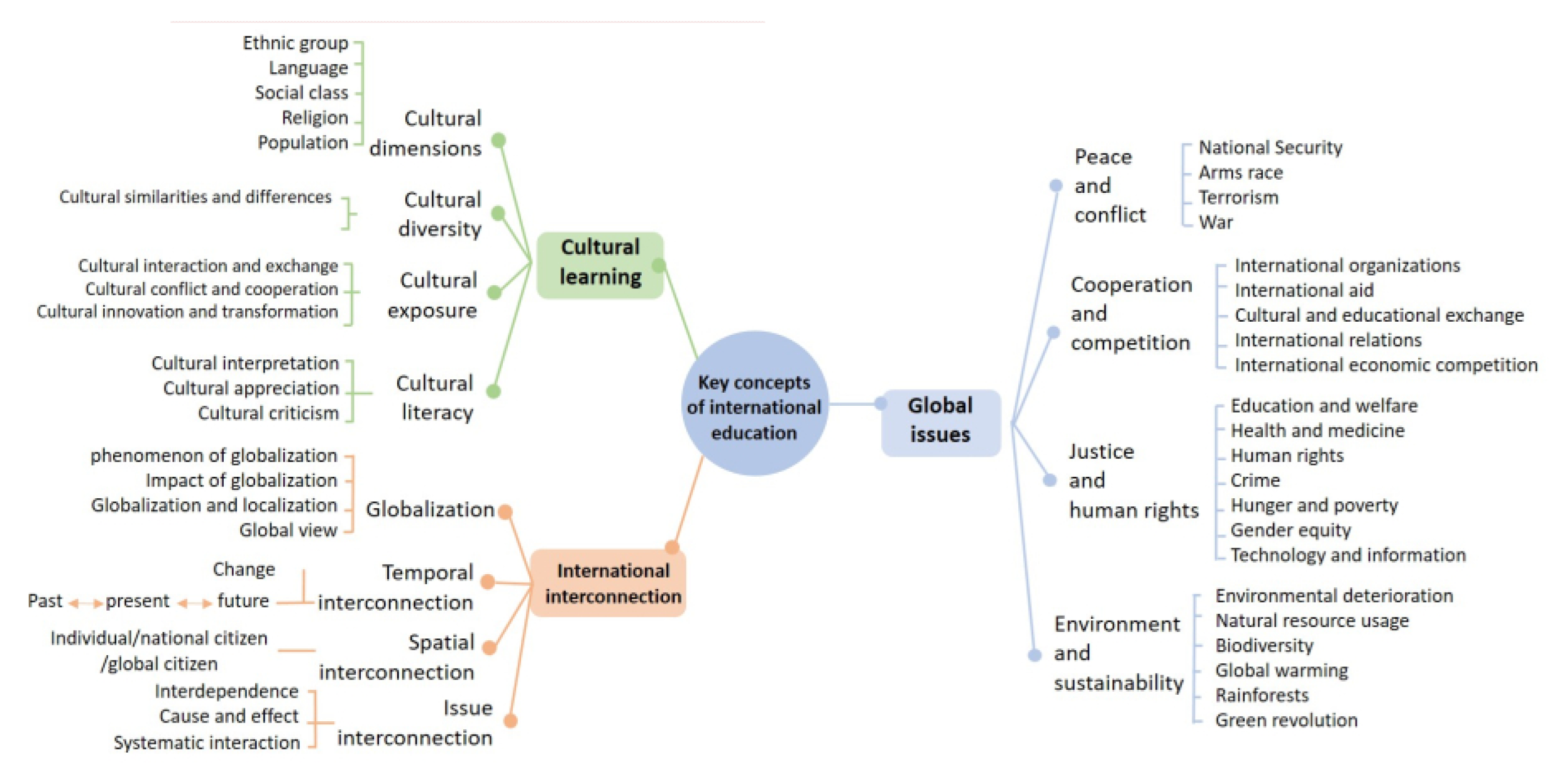
Image description: Mind map of key concepts of international education
A mind map of the key concepts of international education. The center, "Key concepts of international education", branches into three themes, each with sub-concepts and related topics.
Cultural learning
- Cultural dimensions: Ethnic group, Language, Social class, Religion, Population
- Cultural diversity: Cultural similarities and differences
- Cultural exposure: Cultural interaction and exchange, Cultural conflict and cooperation, Cultural innovation and transformation
- Cultural literacy: Cultural interpretation, Cultural appreciation, Cultural criticism
International interconnection
- Globalization: phenomenon of globalization, Impact of globalization, Globalization and localization, Global view
- Temporal interconnection: Change; Past ↔ present ↔ future
- Spatial interconnection: Individual/national citizen/global citizen
- Issue interconnection: Interdependence, Cause and effect, Systematic interaction
Global issues
- Peace and conflict: National Security, Arms race, Terrorism, War
- Cooperation and competition: International organizations, International aid, Cultural and educational exchange, International relations, International economic competition
- Justice and human rights: Education and welfare, Health and medicine, Human rights, Crime, Hunger and poverty, Gender equity, Technology and information
- Environment and sustainability: Environmental deterioration, Natural resource usage, Biodiversity, Global warming, Rainforests, Green revolution